

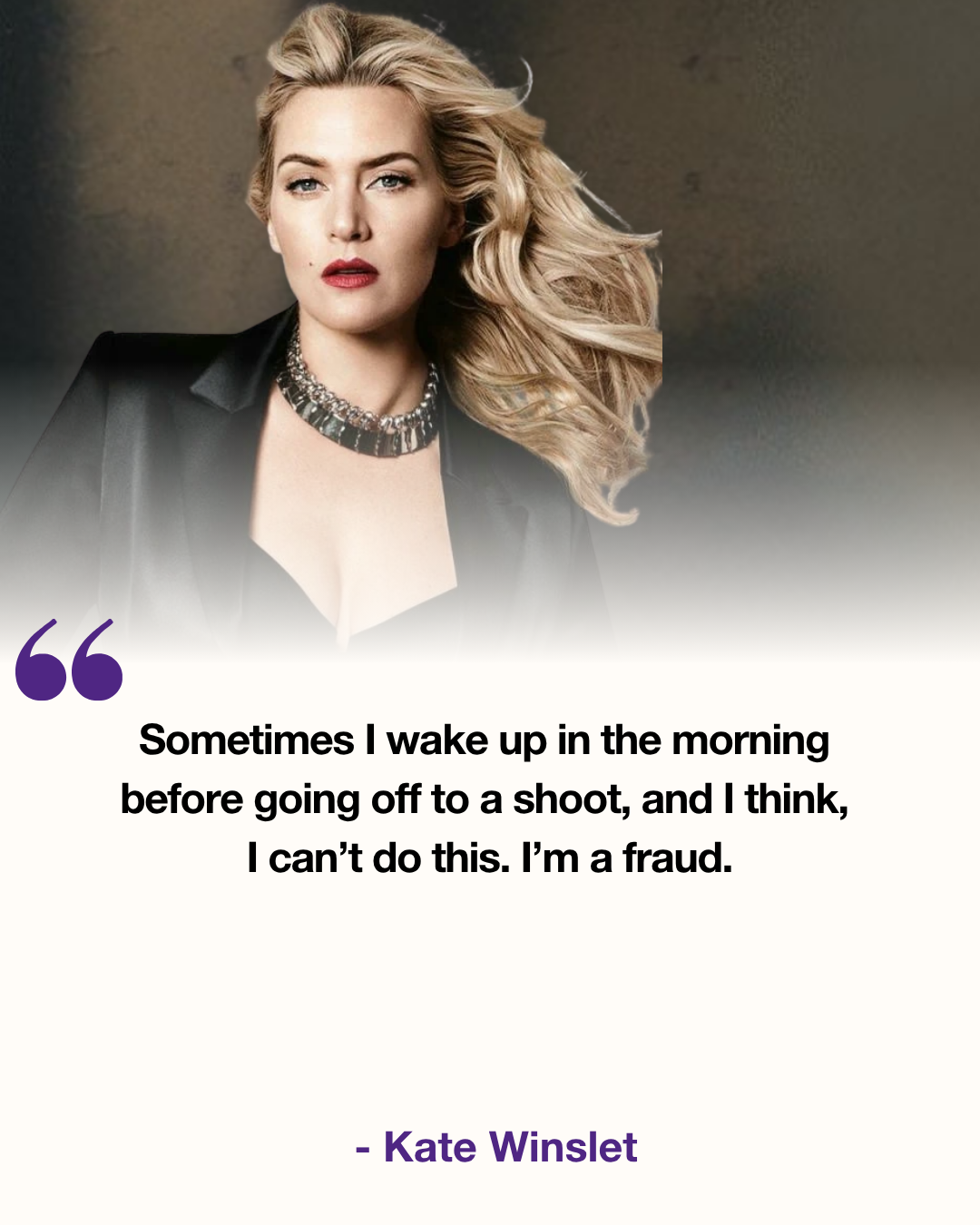
 Maya Angelou, poet, memoirist, civil rights activist, and recipient of the Presidential Medal of Freedom, once confided: "Each time I think — uh oh… I've run a game on everybody, and they’re going to find me out."
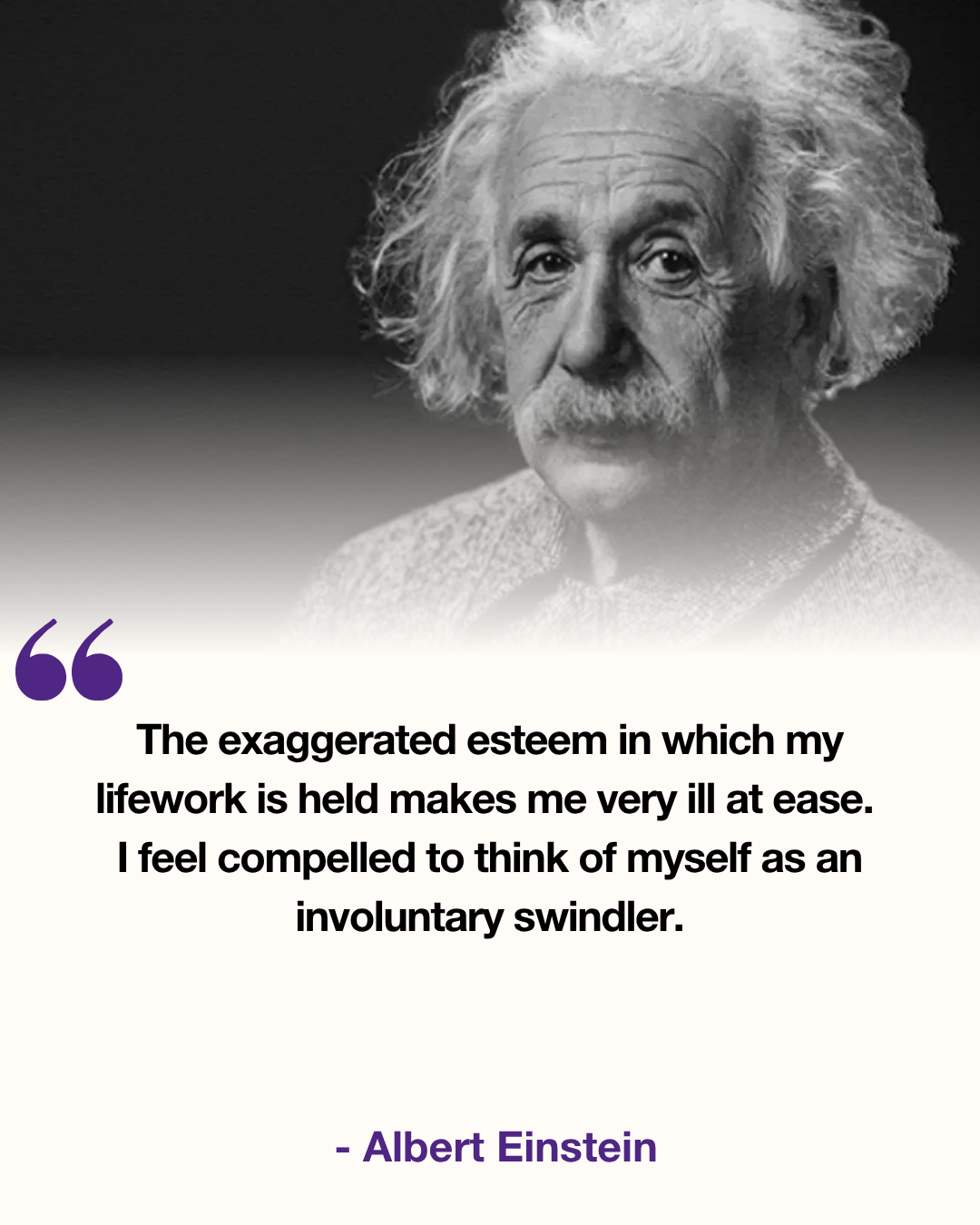
Albert Einstein called himself an "involuntary swindler." Meryl Streep questions why anyone would want to see her in another film. Tom Hanks, two-time Oscar winner, said: “When are they going to discover that I am, in fact, a fraud and take everything away from me?”
These are not outliers. These are not people who slipped through the cracks of an otherwise confident world. These are among the most accomplished human beings of our time.
What they’re experiencing is not the truth about who they are. It’s a neurological pattern that can be interrupted, rewired, and transformed.
This blog explores what imposter syndrome is, what’s happening in your brain when it strikes, how it shapes your behavior, and a simple, science-backed strategy to interrupt it — the next time it shows up.
What Is Imposter Syndrome?
Originally called the Impostor Phenomenon — deliberately not a “syndrome” because that word implies pathology. And this is not a disorder.
The term was coined in 1978 to describe something that occurred again and again, especially in high-achievers: a persistent, internal experience of believing you are not as competent as others perceive you to be, and living in fear that one day, someone will find out.
It’s a subjective experience of phoniness in individuals who, despite objective evidence of success (degrees, recognition, awards, certifications), believe they are imposters and fear exposure. They often attribute accomplishments to luck, timing, or over-preparation rather than genuine ability.
 The cost is not just the feeling, but the decisions it drives. The opportunity you hesitate to take. The visibility you hold back from. The standard you quietly lower. Not because you’re incapable, but because your internal filter is misreading reality.
Research confirms it affects more than 70% of people at some point in their lives — disproportionately the driven, capable, and ambitious.
It’s not something you outgrow simply by achieving more. Actually, the higher you climb, the louder it often gets.
While not a clinical diagnosis in the DSM-5, imposter syndrome is a persistent psychological pattern directly linked to self-doubt, anxiety, burnout, and the habit of holding back from fully embracing success.
Left unexamined, it can cost you the promotion you deserve, the stage you never stepped onto, and the version of yourself you never fully became.
But here's what's rarely said: that same pattern can also fuel your greatest work. The drive, the high standards, the commitment to excellence — those don't disappear when the pattern does. They finally get to work for you rather than against you.
What’s happening with imposter syndrome is that your external success has expanded faster than your internal identity. And the tension you feel is the gap between the two.
If you're starting a new position, role or venture, and you feel uncertainty — that's not imposter syndrome. It's information; a signal worth listening to. It's telling you to learn, prepare, seek feedback, and keep developing. Imposter syndrome is something different. It's when the evidence of your capability is already there — the track record, the results, yet the feeling of fraudulence persists anyway. That gap, between what is objectively true and what you feel, is what we're addressing here.
Two Forces That Shape Your Reality
When I was 19 years old, I had a conversation with Tony Robbins that offered insight into breaking free of this pattern (even though I hadn’t heard of “imposter syndrome” back then).
He said: "Two things will impact your life more than anything else: what you FOCUS on, and the MEANING you give to the experiences of your life."
At the time, I didn't fully grasp the neuroscience behind what he was saying. Now I do.
Your brain's Reticular Activating System (RAS) acts as a gatekeeper, filtering what reaches your conscious awareness and what doesn’t. If you focus on “not being good enough,” you’ll find “not good enough.” But when you focus on capability, you find that instead.
 Here's what's fascinating: the protective patterns that accompany imposter syndrome — overworking, overpreparing, micromanaging, seeking validation, overthinking, overachieving, struggling to feel satisfied — are not unique to imposter syndrome.
Two people can exhibit the exact same behaviors and arrive at different outcomes. One assigns a meaning that traps them in the imposter loop. The other assigns a meaning that fuels growth.
These same patterns can keep you humble, hungry, and committed to continuous improvement. But when the meaning behind them is rooted in fear rather than purpose, they stop serving you — and start costing you.
The same behavior can liberate one person and imprison another. The difference is in the meaning they give to it. This is where cognitive reframing meets neuroplasticity.
This Isn't "Positive Thinking." It’s Accurate Perception.
If you objectively have expertise, experience, recognition, and most importantly consistent, outstanding results, then "I have high standards" is a more accurate interpretation than "I'm a fraud."
You're not making up a meaning. You're choosing the meaning that aligns with evidence.
If you're a high-performing leader who recognizes this pattern, and is ready to do something about it, I'm opening 3 spaces for private, one-on-one work. Details below.
Why Willpower Alone Never Works:
The Neuroscience of The Imposter Loop
Your Brain Is Not Broken. It's Caught in a Loop
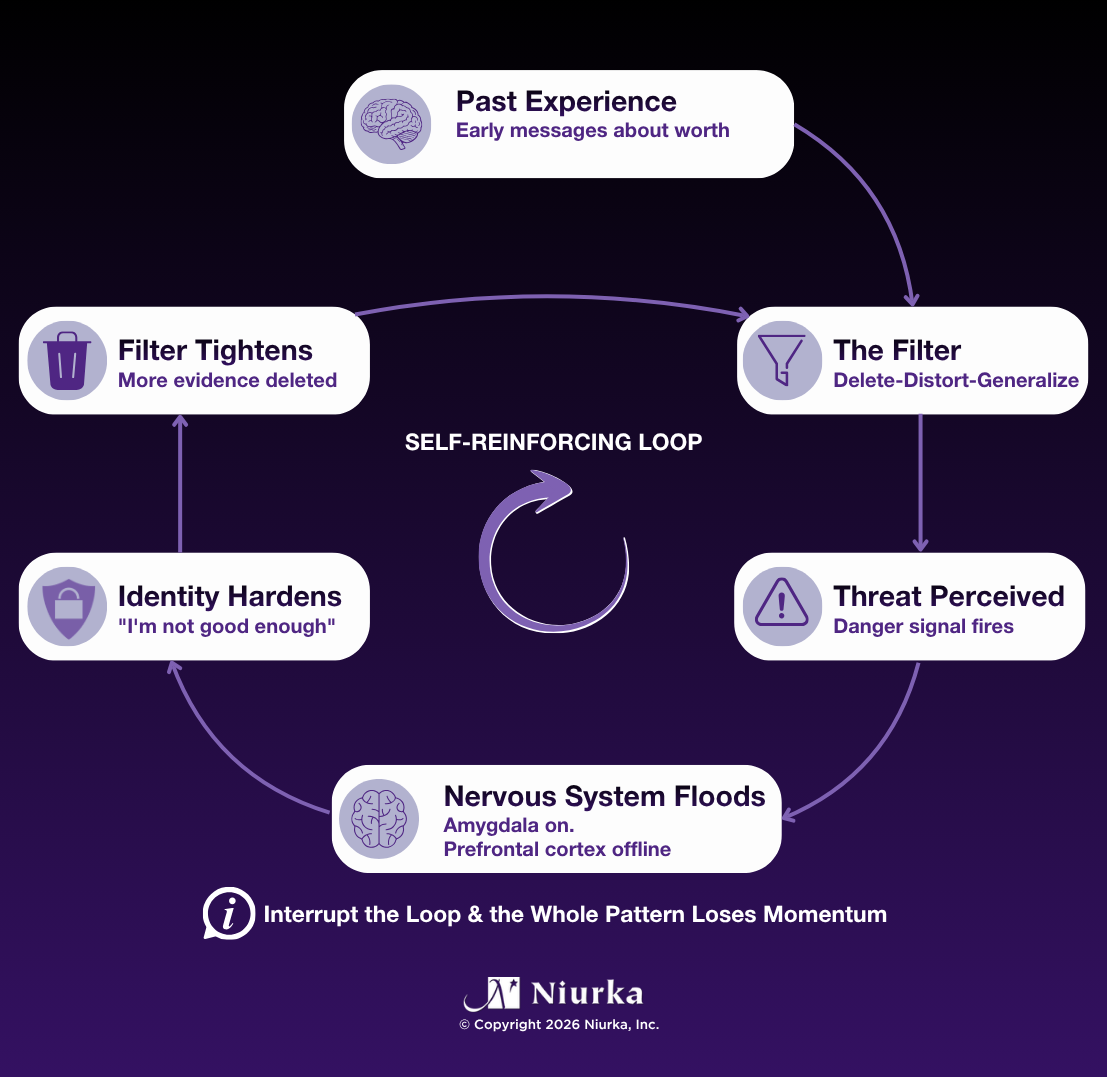 Imposter syndrome is not a single problem. It is a multi-dimensional, self-reinforcing neurological feedback loop, driven by the brain’s threat-detection and self-evaluation systems.
The great news is — it can be entered, and interrupted, at any point.
Here’s the loop:
→ Past Experiences
It begins long before a triggering moment arrives. Past experiences and early messages, from the imprinting stages of childhood, about your worth, belonging, and capability shape the filters through which you interpret reality.
→ The Filters: Delete, Distort, Generalize
Science confirms 11 million bits of data come in through your senses every second, but your conscious mind can only process about 40-60 bits (neuroscience research shows often less than that!). We’re constantly deleting, distorting, and generalizing reality.
Your filters are gatekeepers — deciding what you notice, what you ignore, and what you twist to fit your existing story. Crucially, these filters determine what registers as a threat.
→ Threat Perceived & Danger Signal Fires
If you believe: "I am not enough," the nervous system doesn't need external provocation. It can generate a threat signal on its own.
Your brain's threat detection system is doing its job — just with faulty input.
→ Nervous System Floods
The amygdala (your brain's alarm center) activates as though judgment or exposure were actual physical danger because to the nervous system, social threat registers much like a survival threat. This floods your body with cortisol, creating what neuroscientists call an amygdala hijack. Your prefrontal cortex (rational thinking) goes offline.
In this flooded state, attention narrows — scanning for evidence of inadequacy while filtering out evidence of capability. And repeated negative self-talk strengthens these neural pathways.
Each time you reinforce the doubt, you're wiring your brain to diminish the reward signals after success. The filter tightens, finding even more evidence of inadequacy, and deleting evidence of your true abilities.
→ Identity Hardens
The distorted picture turns into identity: "I am not good enough." "I am a fraud." "They will find me out."
→ Filter Tightens & More Evidence Deleted
That false identity becomes the new input that shapes the filter, and the loop begins again.
This is why imposter syndrome can feel inescapable. You’re caught in a neurological circuit.
But the good news is: neuroplasticity means this loop can absolutely be rewired.
The way out is not to fight the loop. It’s to recognize and interrupt it, at any point, deliberately and repeatedly, until the filter begins to change.
How to Interrupt the Imposter Loop
Step 1: Become Aware of Your State of Being
Awareness is the first step to transformation. The moment you notice that old feeling — the tightness in your chest, the spiral of self-doubt, the voice saying "I’m not enough." Pause. This moment matters — you’ve just interrupted the pattern.
Step 2: Name It & Reframe It
Language matters. Instead of saying "I don’t have what it takes," say: "I'm experiencing that old pattern." Remember, it’s an old pattern, not your true identity.
You are not the pattern. You are the one observing it.
Step 3: Interrupt & Inhale a Breath
A conscious breath is the fastest way to interrupt the threat response and bring your prefrontal cortex back online.
Inhale slowly for 6 counts. Hold for 6. Exhale for 8. This is not woo-woo. It’s neuroscience.
Deep breathing activates the parasympathetic nervous system, signaling to your brain that you are safe.
Step 4: Shift Your Physiology
Imposter syndrome has a physiology: shoulders hunched, breathing shallow, chest tight, gaze down. Interrupt this old state by shifting your body language.
Ask yourself: “How does courage stand? How does curiosity move?”
Courage stands tall. Curiosity leans in. Shift your body, and your brain will follow.
Curiosity can be the bridge. Access the physiology of curiosity, then step into courage.
Step 5: Ask a Better Question
Your brain is constantly assigning meaning. It will answer whatever question you ask it.
When you ask a better question, you get better answers.
Instead of asking: “What if I don’t have what it takes?”
Ask: "How can I be present, and embody my authentic, courageous self right now?"
Your RAS will immediately scan for evidence in alignment with the presuppositions in the questions you ask.
Step 6: Find Evidence
Now deliberately turn your attention toward the record that already exists. Think of a specific result you created, a challenge you faced and overcame, a moment where your capability was undeniable.
Name it clearly — in as much detail as you can. Your RAS filtered this evidence out when the imposter loop was running. You are now instructing it to find what was always there. Evidence of competence, resilience, and impact. The case for who you truly are has always been stronger than the case against you. You're simply choosing to see it.
A Final Note: This Takes Practice
The brain's threat detection system has evolutionary priority — it's designed to keep you safe. Reframing may not feel natural at first. The old pattern may still show up. But with focus and repetition, the new pathway will become your new default.
That's neuroplasticity in action.
Every time you catch the pattern, name it, breathe, shift your body, and ask a better question — you are literally rewiring your brain.
 Invitation for 3 Leaders Ready to Rewire
If you're a founder, CEO, or entrepreneur navigating imposter syndrome, or any other pattern blocking your next level — this is for you.
I'll be selecting 3 leaders to work with… privately and closely, one-on-one, for major personal and professional breakthroughs.
This is not group coaching. This is direct, personalized rewiring of the neurological patterns shaping your decisions, visibility, impact, and fulfillment.
Maya Angelou, poet, memoirist, civil rights activist, and recipient of the Presidential Medal of Freedom, once confided: "Each time I think — uh oh… I've run a game on everybody, and they’re going to find me out."
Albert Einstein called himself an "involuntary swindler." Meryl Streep questions why anyone would want to see her in another film. Tom Hanks, two-time Oscar winner, said: “When are they going to discover that I am, in fact, a fraud and take everything away from me?”
These are not outliers. These are not people who slipped through the cracks of an otherwise confident world. These are among the most accomplished human beings of our time.
What they’re experiencing is not the truth about who they are. It’s a neurological pattern that can be interrupted, rewired, and transformed.
This blog explores what imposter syndrome is, what’s happening in your brain when it strikes, how it shapes your behavior, and a simple, science-backed strategy to interrupt it — the next time it shows up.
What Is Imposter Syndrome?
Originally called the Impostor Phenomenon — deliberately not a “syndrome” because that word implies pathology. And this is not a disorder.
The term was coined in 1978 to describe something that occurred again and again, especially in high-achievers: a persistent, internal experience of believing you are not as competent as others perceive you to be, and living in fear that one day, someone will find out.
It’s a subjective experience of phoniness in individuals who, despite objective evidence of success (degrees, recognition, awards, certifications), believe they are imposters and fear exposure. They often attribute accomplishments to luck, timing, or over-preparation rather than genuine ability.
The cost is not just the feeling, but the decisions it drives. The opportunity you hesitate to take. The visibility you hold back from. The standard you quietly lower. Not because you’re incapable, but because your internal filter is misreading reality.
Research confirms it affects more than 70% of people at some point in their lives — disproportionately the driven, capable, and ambitious.
It’s not something you outgrow simply by achieving more. Actually, the higher you climb, the louder it often gets.
While not a clinical diagnosis in the DSM-5, imposter syndrome is a persistent psychological pattern directly linked to self-doubt, anxiety, burnout, and the habit of holding back from fully embracing success.
Left unexamined, it can cost you the promotion you deserve, the stage you never stepped onto, and the version of yourself you never fully became.
But here's what's rarely said: that same pattern can also fuel your greatest work. The drive, the high standards, the commitment to excellence — those don't disappear when the pattern does. They finally get to work for you rather than against you.
What’s happening with imposter syndrome is that your external success has expanded faster than your internal identity. And the tension you feel is the gap between the two.
If you're starting a new position, role or venture, and you feel uncertainty — that's not imposter syndrome. It's information; a signal worth listening to. It's telling you to learn, prepare, seek feedback, and keep developing. Imposter syndrome is something different. It's when the evidence of your capability is already there — the track record, the results, yet the feeling of fraudulence persists anyway. That gap, between what is objectively true and what you feel, is what we're addressing here.
Two Forces That Shape Your Reality
When I was 19 years old, I had a conversation with Tony Robbins that offered insight into breaking free of this pattern (even though I hadn’t heard of “imposter syndrome” back then).
He said: "Two things will impact your life more than anything else: what you FOCUS on, and the MEANING you give to the experiences of your life."
At the time, I didn't fully grasp the neuroscience behind what he was saying. Now I do.
Your brain's Reticular Activating System (RAS) acts as a gatekeeper, filtering what reaches your conscious awareness and what doesn’t. If you focus on “not being good enough,” you’ll find “not good enough.” But when you focus on capability, you find that instead.
Here's what's fascinating: the protective patterns that accompany imposter syndrome — overworking, overpreparing, micromanaging, seeking validation, overthinking, overachieving, struggling to feel satisfied — are not unique to imposter syndrome.
Two people can exhibit the exact same behaviors and arrive at different outcomes. One assigns a meaning that traps them in the imposter loop. The other assigns a meaning that fuels growth.
These same patterns can keep you humble, hungry, and committed to continuous improvement. But when the meaning behind them is rooted in fear rather than purpose, they stop serving you — and start costing you.
The same behavior can liberate one person and imprison another. The difference is in the meaning they give to it. This is where cognitive reframing meets neuroplasticity.
This Isn't "Positive Thinking." It’s Accurate Perception.
If you objectively have expertise, experience, recognition, and most importantly consistent, outstanding results, then "I have high standards" is a more accurate interpretation than "I'm a fraud."
You're not making up a meaning. You're choosing the meaning that aligns with evidence.
If you're a high-performing leader who recognizes this pattern, and is ready to do something about it, I'm opening 3 spaces for private, one-on-one work. Details below.
Why Willpower Alone Never Works: The Neuroscience of The Imposter Loop
Your Brain Is Not Broken. It's Caught in a Loop
Imposter syndrome is not a single problem. It is a multi-dimensional, self-reinforcing neurological feedback loop, driven by the brain’s threat-detection and self-evaluation systems.
The great news is — it can be entered, and interrupted, at any point.
Here’s the loop:
→ Past Experiences
It begins long before a triggering moment arrives.
Past experiences and early messages, from the imprinting stages of childhood, about your worth, belonging, and capability shape the filters through which you interpret reality.
→ The Filters: Delete, Distort, Generalize
Science confirms 11 million bits of data come in through your senses every second, but your conscious mind can only process about 40-60 bits (neuroscience research shows often less than that!). We’re constantly deleting, distorting, and generalizing reality.
Your filters are gatekeepers — deciding what you notice, what you ignore, and what you twist to fit your existing story. Crucially, these filters determine what registers as a threat.
→ Threat Perceived & Danger Signal Fires
If you believe: "I am not enough," the nervous system doesn't need external provocation. It can generate a threat signal on its own.
Your brain's threat detection system is doing its job — just with faulty input.
→ Nervous System Floods
The amygdala (your brain's alarm center) activates as though judgment or exposure were actual physical danger because to the nervous system, social threat registers much like a survival threat. This floods your body with cortisol, creating what neuroscientists call an amygdala hijack. Your prefrontal cortex (rational thinking) goes offline.
In this flooded state, attention narrows — scanning for evidence of inadequacy while filtering out evidence of capability. And repeated negative self-talk strengthens these neural pathways.
Each time you reinforce the doubt, you're wiring your brain to diminish the reward signals after success. The filter tightens, finding even more evidence of inadequacy, and deleting evidence of your true abilities.
→ Identity Hardens
The distorted picture turns into identity: "I am not good enough." "I am a fraud." "They will find me out."
→ Filter Tightens & More Evidence Deleted
That false identity becomes the new input that shapes the filter, and the loop begins again.
This is why imposter syndrome can feel inescapable. You’re caught in a neurological circuit.
But the good news is: neuroplasticity means this loop can be rewired.
The way out is not to fight the loop. It’s to recognize and interrupt it, at any point, deliberately and repeatedly, until the filter begins to change.
How to Interrupt the Imposter Loop
Step 1: Become Aware of Your State of Being
Awareness is the first step to transformation. The moment you notice that old feeling — the tightness in your chest, the spiral of self-doubt, the voice saying "I’m not enough." Pause. This moment matters — you’ve just interrupted the pattern.
Step 2: Name It & Reframe It
Language matters. Instead of saying "I don’t have what it takes," say: "I'm experiencing that old pattern." Remember, it’s an old pattern, not your true identity.
You are not the pattern. You are the one observing it.
Step 3: Interrupt & Inhale a Breath
A conscious breath is the fastest way to interrupt the threat response and bring your prefrontal cortex back online.
Inhale slowly for 6 counts. Hold for 6. Exhale for 8. This is not woo-woo. It’s neuroscience.
Deep breathing activates the parasympathetic nervous system, signaling to your brain that you are safe.
Step 4: Shift Your Physiology
Imposter syndrome has a physiology: shoulders hunched, breathing shallow, chest tight, gaze down. Interrupt this old state by shifting your body language.
Ask yourself: “How does courage stand? How does curiosity move?”
Courage stands tall. Curiosity leans in. Shift your body, and your brain will follow.
Curiosity can be the bridge. Access the physiology of curiosity, then step into courage.
Step 5: Ask a Better Question
Your brain is constantly assigning meaning. It will answer whatever question you ask it.
When you ask a better question, you get better answers.
Instead of asking: “What if I don’t have what it takes?”
Ask: "How can I be present, and embody my authentic, courageous self right now?"
Your RAS will immediately scan for evidence in alignment with the presuppositions in the questions you ask.
Step 6: Find Evidence
Now deliberately turn your attention toward the record that already exists. Think of a specific result you created, a challenge you faced and overcame, a moment where your capability was undeniable.
Name it clearly — in as much detail as you can. Your RAS filtered this evidence out when the imposter loop was running. You are now instructing it to find what was always there. Evidence of competence, resilience, and impact. The case for who you truly are has always been stronger than the case against you. You're simply choosing to see it.
A Final Note: This Takes Practice
The brain's threat detection system has evolutionary priority — it's designed to keep you safe. Reframing may not feel natural at first. The old pattern may still show up. But with focus and repetition, the new pathway will become your new default.
That's neuroplasticity in action.
Every time you catch the pattern, name it, breathe, shift your body, and ask a better question — you are literally rewiring your brain.
Invitation for 3 Leaders Ready to Rewire
If you're a founder, CEO, or entrepreneur navigating imposter syndrome, or any other pattern blocking your next level — this is for you.
I'll be selecting 3 leaders to work with… privately and closely, one-on-one, for major personal and professional breakthroughs.
This is not group coaching. This is direct, personalized rewiring of the neurological patterns shaping your decisions, visibility, impact, and fulfillment.

Leave a ReplyCancel Reply
UPCOMING EXPERIENCES

A Monthly Membership to GROW YOUR MINDSET and SKILLS to Create A Life of Success and Fulfillment

DISCOVER MORE


Learn Sales Mastery Techniques with Master Results Coach and Sales Expert, Niurka
Date - TBA
LIVE Virtual Experience
DISCOVER MORE

A Communication Mastery & Evolved NLP Training Experience
July 23rd - 26th, 2026
LIVE Virtual Experience
DISCOVER MORE

A journey of Personal Transformation. Create a New Beginning... in just 4 days!
Nov. 5 - 8, 2026
LIVE Virtual
FEB. 18 - 21, 2027
IN-PERSON, CANCUN
DISCOVER MORE
Exclusive for Graduates of SIIA.
A LIVE Advanced Virtual Training Experience
March 4 - 7, 2027
LIVE Virtual
DISCOVER MORE

Sacred Adventure of a Lifetime to BALI, Indonesia with Niurka!
June 23 - July 1, 2027
Bali, Indonesia
DISCOVER MORE


Incredible blog Niurka! I have felt this in the past before, I just didn’t know what that feeling was and its interesting science behind it. Fascinating!!! Thank you as always!!